


ASSET ALLOCATION AND MAXIMISING RETURN AND MINIMISING RISK
- E P I C 'S FINANCIAL SERVICES

- Nov 1, 2022
- 5 min read
What Is Asset Allocation?
Asset allocation means spreading your investments across various asset classes. Broadly speaking, that means a mix of shares, bonds, and cash or money market Financial Instruments.
Within these three classes there are subclasses:
Large-cap shares:
Shares issued by companies with a market capitalization above ₹20,000crores in India.
($10 billion in the USA.)
Mid-cap shares:
Shares issued by companies with a market capitalization between ₹5000 crores and 20,000 crores ($2 billion and $10 billion in the USA).
Small-cap shares:
Companies with a market capitalization of less than 5000 crores in India ( $2 billion in the USA)
These equities tend to have a higher risk due to their lower liquidity.
International Financial Instruments:
Any Financial Instruments issued by a foreign company and listed on a foreign exchange.
Emerging markets:
Financial Instruments issued by companies in developing nations. These investments offer a high potential return and a high risk due to their potential for country risk and their lower liquidity.
Fixed-income Financial Instruments:
Highly rated corporate or government bonds that pay the holder a set amount of interest, periodically or at maturity, and return the principal at the end of the period, these financial instruments are less volatile and less risky than stocks.
Money market:
Investments in short-term debt, typically a year or less. Treasury bills (T-bills) are the most common money market investment.
Real estate investment trusts (REITs):
Shares in an investor pool of mortgages or properties.
Maximising Return and Minimising Risk:
The goal of allocating your assets is to minimise risk while meeting the level of return you expect. To achieve that goal, you need to know the risk-return characteristics of the various asset classes. The figure below compares the risk and potential return of some of them:


Equities have the highest potential return but also the highest risk. Treasury bills have the lowest risk because they are backed by the U.S. government, but they also provide the lowest return.
This is the risk-return tradeoff. High-risk choices are better suited to investors who have higher risk tolerance. That is, they can accept wide swings in market prices. A younger investor with a long-term investment account can expect to recover in time. A couple nearing or in retirement may not want to jeopardise their accumulated wealth.
The rule of thumb is that an investor should gradually reduce risk exposure over the years in order to reach retirement with a reasonable amount of money stashed in safe investments.
Equities have the highest potential return but also the highest risk. Treasury bills have the lowest risk but provide the lowest return.
This is why diversification through asset allocation is important. Every investment comes with its own risks and market fluctuations. Asset allocation insulates your entire portfolio from the ups and downs of a single share or class of financial instruments.
So although part of your portfolio may contain more volatile financial instruments that you've chosen based on their potential for higher returns, the other part of your portfolio is devoted to more stable assets.
Deciding What's Right for YouBecause each asset class has its own level of return and risk, investors should consider their risk tolerance, investment objectives, time horizon, and available money to invest as the basis for their asset composition. All of this is important as investors look to create their optimal portfolio.
Investors with a long time horizon and larger sums to invest may feel comfortable with high-risk, high-return options. Investors with smaller sums and shorter time spans may prefer low-risk, low-return allocations.
To make the asset allocation process easier for clients, many investment companies create a series of model portfolios, each composed of different proportions of asset classes. Each portfolio satisfies a particular level of investor risk tolerance. In general, these model portfolios range from conservative to very aggressive


A Conservative Portfolio:
Conservative model portfolios generally allocate a large percentage of the total to lower-risk financial instruments such as fixed-income and money market financial instruments.
The main goal of a conservative portfolio is to protect the principal value of your portfolio. That's why these models are often referred to as capital preservation portfolios.
Even if you are very conservative and are tempted to avoid the share market entirely, some exposure to shares can help offset inflation. You can invest the equity portion in high-quality blue-chip companies or an index fund.


Moderately Conservative Portfolio:
A moderately in conservative portfolio works for the investor who wishes to preserve most of the portfolio's total value but is willing to take on some risk for inflation protection. A common strategy within this risk level is called current income. With this strategy, you choose financial instruments that pay a high level of dividends or coupon payments.


Moderately Aggressive Portfolio:
Moderately aggressive model portfolios are often referred to as balanced portfolios because the asset composition is divided almost equally between fixed-income financial instruments and equities. The balance is between growth and income. Because moderately aggressive portfolios have a higher level of risk than conservative portfolios, this strategy is best for investors with a longer time horizon (generally more than five years) and a medium level of risk tolerance.

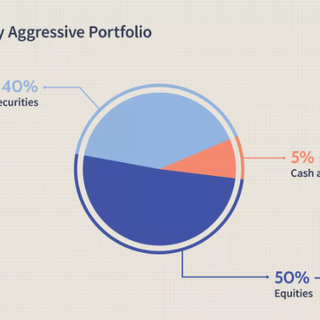
Aggressive Portfolio:
Aggressive portfolios mainly consist of equities, so their value can fluctuate widely from day to day. If you have an aggressive portfolio, your main goal is to achieve long-term growth of capital. The strategy of an aggressive portfolio is often called a capital growth strategy. To provide diversification, investors with aggressive portfolios usually add some fixed-income financial instruments.


A Very Aggressive Portfolio :
Very aggressive portfolios consist almost entirely of stocks. With a very aggressive portfolio, your goal is strong capital growth over a long time horizon. Because these portfolios carry considerable risk, the value of the portfolio will vary widely in the short term.


Tailor Your Allocations:
These model portfolios and the strategies that go with them can offer only a loose guideline. You can modify the proportions to suit your own individual investment needs. How you fine-tune the models above depends on your future financial needs for capital and on the kind of investor you are.
For instance, if you like to research your own companies and devote time to stock picking, you will probably further divide the equities portion of your portfolio into subclasses of stocks. By doing so, you can achieve a specialised risk-return potential within one portion of your portfolio.
Also, the percentage of the portfolio that you devote to cash and money market instruments will depend on the amount of liquidity and safety you need.
If you need investments you can liquidate quickly or you would like to maintain the current value of your portfolio, you might consider putting a larger portion of your investment portfolio in a money market or short-term fixed-income securities.
Investors who do not have liquidity concerns and have a higher risk tolerance will have a smaller portion of their portfolio within these instruments.
Maintaining Your Portfolio :
As you decide how to allocate your portfolio, you might choose one of several basic allocation strategies. Each offers a different approach based on the investor's time frame, goals, and risk tolerance.
When your portfolio is up and running, it's important to conduct a periodic review. That includes a consideration of how your life and your financial needs have changed. Consider whether it's time to change the weighting of your assets.
Even if your priorities haven't changed, you may find that your portfolio needs to be rebalanced. That is, if a moderately aggressive portfolio racked up a lot of gains from stocks recently, you might move some of that profit into safer money market investments.
Asset allocation is a fundamental investing principle that helps investors maximise profits while minimising risk. The different asset allocation strategies described above cover a wide range of investment styles, accommodating varying risk tolerance, time frames, and goals.
When you've chosen an asset allocation strategy that's right for you, remember to review your portfolio periodically to ensure that you're maintaining your intended allocation
Comments